
Yesterday we were still talking about this: a partner team of 3 people finished 121 episodes in 3 days, and on launch day it shot to No. 4 on Douyin’s short-drama new-release chart.
Used Script Mode: From Script to Hitting the New-Drama Chart in Just 3 Days
Today, another drama went live.
7 people, 6 days, 509 episodes. On launch day, heat on Hongguo broke 40 million!

7 people finishing 509 episodes in 6 days basically pushes efficiency to the limit. That many people can move forward together because of the team collaboration features: the same drama, the same project, and everyone can divide the work. And it wasn’t only fast — within just one day of launch, Hongguo heat already passed 40 million.
What they used was Script Mode in Bollo.Video.
The way Script Mode works is actually very direct.
Upload the script. Formats supported: TXT, PDF, DOCX, DOC. Create a project, and Script Mode is the default. From there it isn’t people copy-pasting section by section inside the software. The Agent first finishes reading the whole drama, then breaks it down in the order a real production would actually start work.
Step one: break out the assets
Characters, scenes, and props become cards in the project, with image-generation prompts written at the same time — this most time-consuming round of breakdown is finished by the Agent first. Open this drama’s asset page and Su Chen, Pang Fei, Lin Yiming, and Xu Ying are all there, with looks, multiple angles, and short bios. No matter which episode you get to later, all seven people use the same set of assets. You don’t have to keep flipping through reference images, and you don’t have to type the prompts again by hand. If you need to change a look, you change it once.

Step two: break out the storyboards
The Agent will likewise finish the most time-consuming breakdown for you. The whole drama is spread into a storyboard table arranged by episode, scene, and shot. Every storyboard card has a shot description, the characters who appear, the scene they’re in, the props that are used, and a storyboard prompt you can take straight to generation. Characters and scenes no longer have to be written as “a woman in period costume” or “an old house.” They are pinned back to those assets from a moment ago: still that same person, still that same room.
The person’s job at this step changes. You don’t have to start a storyboard from a blank page. You review: do we need this shot, is this line of emotion right, does this prompt need a few words changed. Once you’ve reviewed it, pick a model, set the duration, and you can generate.
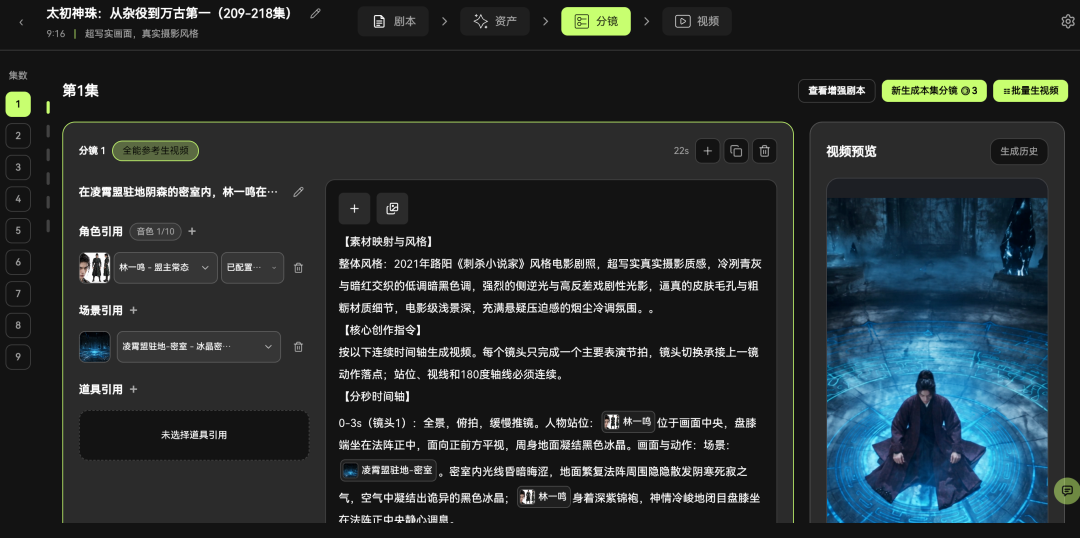
Being able to make 509 episodes in 6 days is not about turning 7 people into 7 output machines. It comes from having the most time-consuming breakdown done for a first pass, so people can keep their energy for judgment and polish. Seven people looking at the same script, the same set of assets, and the same storyboard table can divide work by episode without ending up with seven different dramas.
The speed comes from here. So does the stability.
Script Mode is not only about speed
If the story stopped at “509 episodes finished in 6 days,” it would still just be a production-capacity news item. What actually gives these numbers weight is what happened after launch: in just one day, heat on Hongguo broke 40 million.
On Hongguo, 40 million heat is often treated as the reference line for a drama crossing into hit territory. It is not a bonus for how fast you published, and you don’t get more of it just because you produced more. Heat looks more at whether the audience is willing to watch, willing to stay, and willing to keep following.
So crossing that line on launch day cannot be explained as “we made it fast” alone.
Speed solves being done in time and going live in time. Whether the audience accepts it depends on whether the characters stand, whether the shots flow, and whether the story can keep people. That this drama could get a result like this within a day of launch means two things were true at once: the production line was fast enough, and the quality of the finished episodes held up.
What a tool can do is compress the cycle and hold consistency, so the creator’s judgment has time to be seen. Whether the story is good to watch is still the production team’s own craft. But now you can see this: when efficiency and quality stop undercutting each other, a volume like 500 episodes can still be finished in time — and seen.
If you happen to have a script in hand, and a team with you, and you want both efficiency and quality, Bollo.Video’s Script Mode is a fit!
You’re also welcome to join the Bollo.Video user group. It’s full of battle-tested creators, and we’d love to trade notes from real production. Scan the code to join 👇

The official site is Bollo.Video. If you have a script, you can drag it in and try it.
If you were the one making these 509 episodes, which step would you worry would go wrong first? We can talk in the comments. 👇